
Directions: Answer the questions based on the following information.
Sixteen teams have been invited to participate in the ABC Gold Cup cricket tournament. The tournament was conducted in two stages. In the first stage, the teams are divided into two groups. Each group consists of eight teams, with each team playing every other team in its group exactly once. At the end of the first stage, the top four teams from each group advance to the second state while the rest are eliminated. The second stage comprised several rounds. A round involves one match for each team the winner of a match in a round advances to the next term, while the loser is eliminated. The team that remains undefeated in the second stage is declared the winner and claims the Gold Cup.
The tournament rules are such that each match resultls in a winner and a loser with no possiblitiy of a tie. In the first stage, a team earns one point for each win and no points for a loss. At the end of the first stage, teams in each group are ranked on the basis of total points to deternine the qualifiers advancing to the next stage. Ties are resolved by a series of complex tie breaking rules so that exactly four teams from each group advance to the next stage.
Question 1:
What is the total number of matches played in the tournament?
(a) 28
(b) 55
(c) 63
(d) 35
Question 2:
The minimum number of wins needed for a team in the first stage to guarantee its advancement to the next stage is:
(a) 5
(b) 6
(c) 7
(d) 4
Question 3:
What is the highest number of wins for a team in the first stage inspite of which it would be eliminated at the end of first stage?
(a) 1
(b) 2
(c) 3
(d) 4
Question 4:
What is the number of rounds in the second stage of the tournament?
(a) 1
(b) 2
(c) 3
(d) 4
Solution
1. There will be eight team in each group. Each team in a group will play
with every other team.Hence, total number of matches will be 7x8/2=28 in
one group.Hence in both the groups, there will be 56 matches. This is for
the first stage. Again, there are 8 teams in knockout rounds from which
one winner emerges or 7 losers are identified. Hence 7 more matches will
be played. So the total number of matches played will be 63.
2. The minimum number of wins that can assume a place in the second
stage is 6.
3. The highest number of wins for a team is 4.
4. Since, there are 8 teams, there would be 7 matches in 3 rounds
Directions (Q. 1-6): Study the following information to answer the given questions:
Twelve people are sitting in two parallel rows containing six people each such that they are equidistant from each other. In row 1: P, Q, R, S, T and V are seated and all of them are facing South. In row 2: A, B, C, D, E and F are seated and all of them are facing North. Therefore, in the given seating arrangement, each member seated in a row faces another member of the other rowS sits third to the right of Q. Either S or Q sits at an extreme end of the line. The one who faces Q sits second to
the right of E. Two people sit between B and F. Neither B nor F sits at an extreme end of the line. The immediate neighbour of B faces the person who sits third to the left of P. R and T are immediate neighbours. C sits second to the left of A. T does not face the immediate neighbour of D.
1. Who amongst the following sit at the extreme ends of the rows?
1) S, D
2) Q, A
3) V, C
4) P, D
5) Q, F
2. Who amongst the following faces S?
1) A
2) B
3) C
4) D
5) F
3. How many persons are seated between V and R?
1) One
2) Two
3) Three
4) Four
5) None of these
4. P is related to A in the same way as S is related to B based on the given arrangement. Which of the following is T related to, following the same pattern?
1) C
2) D
3) E
4) F
5) Cannot be determined
5. Which of the following is true regarding T?
1) F faces T.
2) V is an immediate neighbour of T.
3) F faces the one who is second to the right of T.
4) T sits at one of the extreme ends of the line.
5) Q sits second to the right of T.
6. Four of the following five are alike in a certain way based on the given arrangement and so form a group. Which is the one that does not belong to that group?
1) A–T
2) B–T
3) F–P
4) C–V
5) E–Q
Ans:
1. -4
2. -1
3. -2
4. -2
5. -3
6. -5
Twelve people are sitting in two parallel rows containing six people each such that they are equidistant from each other. In row 1: P, Q, R, S, T and V are seated and all of them are facing South. In row 2: A, B, C, D, E and F are seated and all of them are facing North. Therefore, in the given seating arrangement, each member seated in a row faces another member of the other rowS sits third to the right of Q. Either S or Q sits at an extreme end of the line. The one who faces Q sits second to
the right of E. Two people sit between B and F. Neither B nor F sits at an extreme end of the line. The immediate neighbour of B faces the person who sits third to the left of P. R and T are immediate neighbours. C sits second to the left of A. T does not face the immediate neighbour of D.
1. Who amongst the following sit at the extreme ends of the rows?
1) S, D
2) Q, A
3) V, C
4) P, D
5) Q, F
2. Who amongst the following faces S?
1) A
2) B
3) C
4) D
5) F
3. How many persons are seated between V and R?
1) One
2) Two
3) Three
4) Four
5) None of these
4. P is related to A in the same way as S is related to B based on the given arrangement. Which of the following is T related to, following the same pattern?
1) C
2) D
3) E
4) F
5) Cannot be determined
5. Which of the following is true regarding T?
1) F faces T.
2) V is an immediate neighbour of T.
3) F faces the one who is second to the right of T.
4) T sits at one of the extreme ends of the line.
5) Q sits second to the right of T.
6. Four of the following five are alike in a certain way based on the given arrangement and so form a group. Which is the one that does not belong to that group?
1) A–T
2) B–T
3) F–P
4) C–V
5) E–Q
Ans:
1. -4
2. -1
3. -2
4. -2
5. -3
6. -5
Directions (1-5): Study the following information and answer the following questions.
Eight people E, F, G, H, J, K, L and M are sitting around a circular table facing the centre. Each of them is of a different profession Chartered Accountant, Columnist, Doctor, Engineer, Financial Analyst, Lawyer, Professor and Scientist but not necessarily in the same order. F is sitting second to the left of K. The Scientist is an immediate neighbour of K. There are only three people between the Scientist and E. Only one person sits between the Engineer and E. The Columnist is to the immediate right of the Engineer. M is second to the right of K. H is the Scientist. G and J are immediate neighbours of each other. Neither G nor J is an Engineer. The Financial Analyst is to the immediate left of F. The Lawyer is second to the right of the Columnist. The Professor is an immediate neighbour of the Engineer. G is second to the right of the Chartered Accountant.
1. Who is sitting second to the right of E?
(1) The Lawyer
(2) G
(3) The Engineer
(4) F
(5) K
2. Who amongst the following is the professor?
(1) F
(2) L
(3) M
(4) K
(5) J
3. Four of the following five are alike in a certain way based on the given arrangement and hence from a group. Which of the following does not belong to that group?
(1) H - Chartered Accountant
(2) M - Doctor
(3) J - Engineer
(4) Financial Analyst - L
(5) Lawyer - K
4. What is the position of L with respect to the Scientist?
(1) Third to the left
(2) Second to the right
(3) Second to the left
(4) Third to the right
(5) Immediate right
5. Which of the following statements is true according to the given arrangement?
(1) The lawyer is second to the left of the Doctor
(2) E is an immediate neighbour of the Financial Analyst
(3) H sits exactly between F and the Financial Analyst
(4) Only four people sit between the Columnist and F
(5) All of the given statements are true
Answers:
1 (2)
2 (4)
3 (3)
4 (2)
5 (1)

Directions (Q. 1-7): Study the following informationcarefully and answer the given questions.
Eight colleagues, A, B, C, D, E, F, G and H, are sitting around a circular table facing the centre but not necessarily in the same order. Each one of them holds a different post — Manager, Company Secretary, Chairman, President, Vice President, Group Leader, Financial Advisor and Managing
Director. A sits third to the right of the Managing Director. Only two people sit between the Managing Director and H. The Vice President and the Company Secretary are immediate neighbours. Neither A nor H is a Vice President or a Company Secretary. The Vice President is not an immediate neighbour of the Managing Director. The Manager sits second to the left of E. E is not an immediate neighbour of H. The Manager is an immediate neighbour of both the Group Leader and the
Financial Advisor. The Financial Advisor sits third to the right of B. B is not the Vice President. C sits on the immediate right of the Chairman. A is not the Chairman. F is not an immediate neighbour of A. G is not an immediate neighbour of the Manager.
1. Who amongst the following sits third to the left of E?
1) Manager
2) G
3) A
4) Financial Advisor
5) B
2. Four of the following five are alike in a certain way based on the given arrangement and thus form a group. Which is the one that does not belong to that group?
1) F–Chairman
2) G–President
3) D–Manager
4) A–Financial Advisor
5) B–Managing Director
3. Who among the following is the President of the company?
1) A
2) C
3) H
4) G
5) D
4. Which of the following is true with respect to the given seating arrangement?
1) The Group Leader of the company is an immediate neighbour of the Vice President.
2) G sits second to the right of D.
3) The Group Leader and the Company Secretary are immediate neighbours.
4) The Chairman of the company sits to the immediate left of the Managing Director.
5) The Group Leader sits second to the left of D.
5. Which of the following posts does B hold in the company?
1) Chairman
2) Manager
3) Company Secretary
4) Vice President
5) Financial Advisor
6. Who among the following sits exactly between the Managing Director and H?
1) H and the Chairman
2) B and G
3) The Chairman and C
4) F and C
5) E and the Group Leader
7. Who among the following is the Group Leader?
1) C
2) F
3) G
4) H
5) A
Anwers:-
1.- 4
2.- 5
3.- 1
4.- 4
5. -3
6.- 5
7.- 2
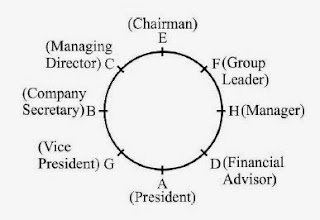
Eight colleagues, A, B, C, D, E, F, G and H, are sitting around a circular table facing the centre but not necessarily in the same order. Each one of them holds a different post — Manager, Company Secretary, Chairman, President, Vice President, Group Leader, Financial Advisor and Managing
Director. A sits third to the right of the Managing Director. Only two people sit between the Managing Director and H. The Vice President and the Company Secretary are immediate neighbours. Neither A nor H is a Vice President or a Company Secretary. The Vice President is not an immediate neighbour of the Managing Director. The Manager sits second to the left of E. E is not an immediate neighbour of H. The Manager is an immediate neighbour of both the Group Leader and the
Financial Advisor. The Financial Advisor sits third to the right of B. B is not the Vice President. C sits on the immediate right of the Chairman. A is not the Chairman. F is not an immediate neighbour of A. G is not an immediate neighbour of the Manager.
1. Who amongst the following sits third to the left of E?
1) Manager
2) G
3) A
4) Financial Advisor
5) B
2. Four of the following five are alike in a certain way based on the given arrangement and thus form a group. Which is the one that does not belong to that group?
1) F–Chairman
2) G–President
3) D–Manager
4) A–Financial Advisor
5) B–Managing Director
3. Who among the following is the President of the company?
1) A
2) C
3) H
4) G
5) D
4. Which of the following is true with respect to the given seating arrangement?
1) The Group Leader of the company is an immediate neighbour of the Vice President.
2) G sits second to the right of D.
3) The Group Leader and the Company Secretary are immediate neighbours.
4) The Chairman of the company sits to the immediate left of the Managing Director.
5) The Group Leader sits second to the left of D.
5. Which of the following posts does B hold in the company?
1) Chairman
2) Manager
3) Company Secretary
4) Vice President
5) Financial Advisor
6. Who among the following sits exactly between the Managing Director and H?
1) H and the Chairman
2) B and G
3) The Chairman and C
4) F and C
5) E and the Group Leader
7. Who among the following is the Group Leader?
1) C
2) F
3) G
4) H
5) A
Anwers:-
1.- 4
2.- 5
3.- 1
4.- 4
5. -3
6.- 5
7.- 2

Directions (Q. 1-5): Study the following informationcarefully and answer the given questions.
Study the following information and answer the following questions.
Study the following information and answer the following questions.
A, B, C, D, E, G, and I are seven friends who study in three different standards namely 5th, 6th, 7th such that not less than two friends study in the same standard. Each friend also has a different favourite subject namely History, Civics, English, Marathi, Hindi, Maths and Economics but not necessarily in the same order.
A like Maths and studies in 5th standard with only one other friends who likes Marathi. I studies with two other friends. Both the friends who study with I like language (here languages include only Hindi, Marathi and English).
D studies in 6th standard with only one person and does not like Civics. E studies with only one friend. The one who likes history does not study in 5th or 6th standard. E does not like languages. C does not like English, Hindi or Civics.
1. Which combination represents E's favourite subject and the standard in which he studies?
(1) Civics and 7th
(2) Economics and 5th
(3) Civics and 6th
(4) History and 7th
(5) Economics and 7th
2. Which of the following is I's favourite subject?
(1) History
(2) Civics
(3) Marathi
(4) Either English or Marathi
(5) Either English or Hindi
3. Who amongst the following studies in 7th standard?
(1) G
(2) C
(3) E
(4) D
(5) Either D or B
4. Which of the combination is definitely correct?
(1) I and Hindi
(2) G and English
(3) C and Marathi
(4) B and Hindi
(5) E and Economics
5. Which of the following subject does G like?
(1) Either Maths or Marathi
(2) Either Hindi or English
(3) Either Hindi or Civics
(4) Either Hindi or Marathi
(5) Either Civics or Economics
Answers:
1 (3)
2 (1)
3 (1)
4 (3)
5 (2)
Friends  Standard Subject
A         V       Maths
B         VII     Hindi/English
C         V       Marathi
D         VI      Economics
E         VI      Civics
G         VII     Hindi/English
I         VII     History
Answer


