If you are a fresher or job seeker looking for opportunities with companies that use employability assessments during recruitment, you may have come across the eLitmus pH Test.
The eLitmus assessment is designed to evaluate a candidate's aptitude and problem-solving abilities and can be used by employers as part of their recruitment process.
Preparing for eLitmus can be confusing because information about the test pattern, modules, scoring and preparation is often available across different sources. This guide brings the important information together in one place.
| Assessment | eLitmus pH Test |
| Purpose | Employability and aptitude assessment |
| Common Sections | Quantitative, Verbal and Analytical/Problem Solving |
| Questions | The commonly described format has 60 questions |
| Current 2026 Test Listing | 135-minute mandatory pH Test |
| Optional Component | 75-minute Coding Challenge for applicable test events |
| Scoring | Absolute score and percentile are provided |
Exam structure and test-event instructions can change. Always verify the details applicable to your specific test booking.
What Is the eLitmus Exam?
The eLitmus pH Test is an aptitude and employability assessment used to evaluate skills that can be relevant to recruitment.
According to eLitmus, the pH Test measures a broad range of skills developed through education rather than testing proficiency in one particular academic subject. The assessment expects familiarity with high-school-level mathematics and essential English-language skills.
The test is designed to provide employers with information that can help them evaluate candidates for suitable job opportunities.
What Is the Full Form of eLitmus pH Test?
The assessment is commonly referred to as the eLitmus pH Test, where pH refers to the Hiring Potential Test.
It is primarily an aptitude-based assessment rather than an examination focused on one specific university syllabus.
eLitmus Exam Pattern 2026
The eLitmus pH Test commonly consists of three major areas:
- Quantitative Ability
- Verbal Ability
- Analytical / Problem Solving
The official eLitmus test-taker information describes a commonly used format of 20 questions in each section, for a total of 60 questions, with questions distributed across different difficulty levels. It also notes that the structure may be modified as the testing system evolves.
Current 2026 test-event listings show a 135-minute mandatory pH Test. Some test events also offer an optional 75-minute Coding Challenge, particularly for candidates seeking IT opportunities.
eLitmus Syllabus 2026
The eLitmus pH Test is primarily an aptitude assessment. The three broad areas are Quantitative, Verbal and Analytical/Problem Solving.
Below is a practical preparation framework for each section.
1. Quantitative Ability
The quantitative section tests your ability to understand and solve mathematical problems efficiently.
Important Quantitative Topics
- Number systems
- Percentages
- Profit and loss
- Ratio and proportion
- Averages
- Time and work
- Time, speed and distance
- Simple and compound interest
- Probability
- Permutations and combinations
- Algebra
- Geometry
- Mensuration
- Data interpretation
Do not focus only on memorizing formulas. You should also practice recognizing the shortest and most efficient way to solve a problem.
2. Verbal Ability
The verbal section evaluates important English-language skills.
Important Verbal Topics
- Reading comprehension
- Vocabulary
- Synonyms and antonyms
- Grammar
- Sentence correction
- Sentence completion
- Para jumbles
- Contextual vocabulary
- Sentence construction
Regular reading can improve comprehension speed and vocabulary. Try reading newspaper editorials, quality articles and technical or business content regularly.
3. Analytical Ability / Problem Solving
The analytical section focuses on reasoning, logical thinking and problem-solving ability.
Important Topics to Practice
- Logical reasoning
- Number and letter patterns
- Arrangements
- Logical puzzles
- Data interpretation
- Data sufficiency
- Sequences
- Analytical reasoning
- Problem-solving questions
- Cryptarithmetic and related problem-solving concepts
The exact distribution of topics can vary, so candidates should focus on developing general problem-solving ability rather than memorizing a fixed list of questions.
Does eLitmus Have Negative Marking?
Yes. eLitmus describes its scoring system as using a handicap-based negative-marking approach. The assessment also takes question difficulty and candidate performance into account when determining the final score.
This means that blindly attempting every question is not necessarily the best strategy.
Candidates should focus on balancing:
- Accuracy
- Question selection
- Difficulty level
- Time management
How Is the eLitmus Score Calculated?
eLitmus states that the final score is influenced not only by the number of correct answers but also by the difficulty level of the questions and how other candidates perform on the same questions.
Candidates receive both an absolute score and a percentile score.
This is important because a raw number of correct answers alone does not tell the complete story of performance.
What Is a Good eLitmus Score?
There is no single score that guarantees selection for every employer. Recruitment requirements can vary depending on the company, job role, experience level and hiring program.
A stronger approach is to focus on obtaining a competitive percentile while building the skills required for the roles you are targeting.
eLitmus Coding Challenge
Current 2026 eLitmus test listings show an optional 75-minute Coding Challenge alongside the mandatory pH Test for certain test events. Candidates targeting well-paying IT jobs are encouraged to take the coding component where applicable.
If you are targeting software-development or other technical roles, preparing for the coding challenge can therefore be useful.
Topics to Prepare for Coding
- Programming fundamentals
- Variables and data types
- Conditional statements
- Loops
- Functions
- Arrays and strings
- Basic algorithms
- Problem solving
- Time and space complexity basics
The exact coding requirements can vary, so check the instructions for your specific test event.
eLitmus Eligibility
eLitmus is primarily used by students, fresh graduates and job seekers as an employability assessment.
However, eligibility requirements and job-specific requirements can vary depending on the hiring opportunity.
If you are applying for a particular company through eLitmus, always check the eligibility criteria specified for that position rather than assuming that one general rule applies to every employer.
How to Prepare for eLitmus 2026
A good preparation strategy should focus on three things: concepts, accuracy and speed.
Step 1: Understand the Test Structure
Start by understanding the sections included in your assessment and the instructions associated with your test event.
Step 2: Take a Diagnostic Test
Before beginning intensive preparation, solve a small set of questions from each section.
Record:
- Number of correct answers
- Number of incorrect answers
- Time taken
- Topics where you struggled
Step 3: Strengthen Your Fundamentals
Work on the concepts where your accuracy is low.
For quantitative aptitude, revise the underlying mathematical concepts before attempting large numbers of questions.
Step 4: Practice Difficult Problems
Once your fundamentals are strong, gradually introduce more difficult questions. The goal is not simply to solve easy questions quickly but to become comfortable with different difficulty levels.
Step 5: Improve Question Selection
Because the assessment uses a difficulty-aware scoring approach and negative marking, spending excessive time on one difficult question can be counterproductive.
Learn when to:
- Attempt immediately
- Spend additional time
- Move to another question
Step 6: Take Timed Mock Tests
Mock tests should be taken under realistic conditions.
After each mock test, analyze:
- Incorrect answers
- Questions that took too long
- Questions guessed without sufficient confidence
- Topics responsible for repeated mistakes
30-Day eLitmus Preparation Strategy
| Week | Focus |
|---|---|
| Week 1 | Understand the exam and strengthen basic concepts |
| Week 2 | Topic-wise practice and improve accuracy |
| Week 3 | Difficult questions, speed improvement and section tests |
| Week 4 | Full-length mocks, analysis and final revision |
Common Mistakes to Avoid in eLitmus Preparation
1. Preparing Only Easy Questions
Solving only easy questions may improve confidence but may not adequately prepare you for a competitive aptitude assessment.
2. Ignoring Negative Marking
Random guessing can reduce your overall performance. Practice making sensible attempt-versus-skip decisions.
3. Spending Too Long on One Question
A difficult question can consume valuable time. Develop the habit of moving forward when a problem is taking significantly longer than expected.
4. Taking Mock Tests Without Analysis
A mock test is not just an examination. It is a diagnostic tool. Spend time understanding why you made mistakes.
5. Ignoring the Coding Challenge
If you are targeting technical roles and your test event includes the optional coding component, consider preparing for it instead of focusing exclusively on the aptitude sections.
Frequently Asked Questions About eLitmus 2026
What is the eLitmus pH Test?
The eLitmus pH Test is an aptitude and employability assessment used to evaluate candidates across areas such as quantitative ability, verbal ability and analytical or problem-solving skills.
How many questions are there in the eLitmus pH Test?
The official eLitmus test-taker information currently describes a commonly used format of 60 questions, with 20 questions in each of three sections. However, eLitmus also states that the structure can change over time.
What are the sections in eLitmus?
The commonly described sections are Quantitative, Verbal and Analytical or Problem Solving.
Is there negative marking in eLitmus?
Yes. eLitmus describes its scoring system as using a handicap-based negative-marking approach.
What is the duration of the eLitmus exam?
Current 2026 test-event listings show the mandatory pH Test as 135 minutes. An optional 75-minute Coding Challenge may also be available. Candidates should follow the duration and instructions shown for their particular test event.
Does eLitmus have a coding test?
Current 2026 test listings show an optional 75-minute Coding Challenge for applicable test events. Candidates targeting IT jobs may benefit from taking it.
What is a good eLitmus score?
There is no universal score that guarantees a job. Companies can have different requirements depending on the role and hiring process. Focus on achieving a strong percentile and developing the skills required for your target positions.
Can freshers take the eLitmus test?
The pH Test is used as an employability assessment for candidates including freshers and job seekers. Eligibility for individual job opportunities may vary.
How should I prepare for eLitmus?
Start with the three core areas, strengthen your fundamentals, practice difficult questions, improve speed and accuracy, and take timed mock tests. If you are targeting technical jobs, also prepare for the coding challenge where applicable.
Useful eLitmus Preparation Resources
We are building a collection of eLitmus preparation resources for students and job seekers.
- eLitmus Syllabus 2026: Section-wise Topics
- eLitmus Quantitative Aptitude Questions
- eLitmus Analytical and Logical Reasoning Questions
- eLitmus Verbal Ability Questions
- eLitmus Mock Test 2026
- eLitmus Coding Challenge Preparation
Final Thoughts
The eLitmus pH Test is not an examination that can be prepared for effectively by memorizing a fixed list of questions. A better strategy is to build strong mathematical, verbal and analytical fundamentals and then improve your accuracy, speed and question-selection skills through timed practice.
If you are planning to take eLitmus in 2026, first check the instructions associated with your particular test event. The current 2026 listings show a 135-minute mandatory pH Test and, for applicable events, an optional 75-minute Coding Challenge. The assessment structure can evolve, so the latest official information should always take priority.
We will update this guide when important eLitmus exam information changes.
Disclaimer: This article is for educational and informational purposes. eLitmus test structure, duration, scoring, eligibility, test locations, fees and recruitment processes may change. Always verify the latest information with the official eLitmus website and the instructions provided for your specific test event.

Make eye contact
Don't study grammar too much
Practice Speaking what you hear!
Watch English Movies
Reading Loudly
Talk Face to Face
Give answer:
1) If only statement I is sufficient to answer the question but statement II is not
2) If only statement II is sufficient to answer the question but statement I is not
3) If either statements I or II is sufficient to answer the question
4) If the two statements are not sufficient but still more data is needed to answer the question
5) If both statements I and II are together sufficient to answer the question
1. In which year was Kiran born?
Statements:
I) Kiran at present is 25 years younger to his father.
II) Kiran's brother, who was born in 1964, is 30 years younger to his father.
2. How many children does Ramesh have?
Statements:
I) Harini is the only daughter of Kavita who is wife of Ramesh.
II) Kiran and Ramu are the only brothers of Harini.
3. The last Sunday of June, 2044 fell on which date?
Statements:
I) The first Sunday of that month fell on 5th.
II) The last day of that month was Thursday.
4. What is the code for "innovative" in the code language?
Statements:
I) In the code language, "plan is innovative" is written as "de ra fa".
II) In the same code language, "make it innovative" is written as "de ga jo".
5. How many children are there between A and B in a row of children?
Statements:
I) A is fifteenth from the left in the row.
II) B is exactly in the middle and there are twenty children towards his right.
Directions (6-10): Read the following information carefully and answer the questions given below:
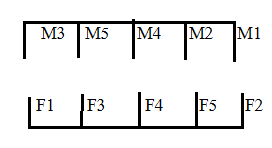
M1, M2, M3, M4 and M5 are five men sitting in a line facing south while F1, F2, F3, F4 and F5 are five ladies sitting in a second line parallel to the first line and are facing North.
M2 who is just next to the left of M4, is opposite to F5.
M3 and F2 are diagonally opposite to each other.
M5 is opposite to F3 who is just next right of F1.
F4 who is just to the left of F5, is opposite to M4.
F1 is at one end of the line.
6. Who is sitting third to the right of F3?
1) F5
2) F2
3) F1
4) F4
5) Data inadequate
7. If M2 shifts to the place of M5, M5 shifts to the place of F5 and F5 shifts to the place of M2, then who will be the second to the left of the person opposite to F3?
1) F5
2) F4
3) M5
4) M4
5) F2
8. Which of the following pair is diagonally opposite to each other?
1) M5F5
2) M2F3
3) M1F2
4) M1F1
5) M2F4
9. If F3 and F4, M1 and M5 and M2 and F5 interchange their positions, then who will be the second person to the right of the person who is opposite to the person second of the right of F4?
1) M4
2) M1
3) M5
4) F3
5) F1
10. In the original arrangement who is sitting just opposite to F2?
1) M2
2) M1
3) M3
4) M4
5) M5
Row Arrangement Solution:
Directions (1-10): Read the following passage carefully and answer the questions given below it.
The importance of communication skills cannot be underestimated especially so in the teaching-learning process. Teaching is generally considered as only fifty percent knowledge and fifty percent interpersonal or communication skills. For a teacher, it is not just important to give a lecture rich in content that provides abundant information about the subject or topic in question, but a successful teacher develops an affinity with, an understanding of and a harmonious interrelationship with her pupils. Building rapport becomes her primary task in the classroom. But what exactly is rapport? Rapport is a sympathetic relationship or understanding that allows you to look at the world from someone else's perspective. Making other people feel that you understand them creates a strong bond. Building rapport is the first step to better communication--the primary goal of all true educators. Communication skills for teachers are thus as important as their in-depth knowledge of the particular subject which they teach. To a surprising degree, how one communicates determines one's effectiveness as a teacher. A study on communication styles suggests that 7% of communication takes place through words, 38% through voice intonation and 55% through body language.
Much of teaching is about sending and receiving messages. The process of communication is composed of three elements; the source (sender, speaker, transmitter or instructor), the symbols used in the composing and transmitting of the message (words or signs), and the receiver (listener, reader, or student). The three elements are dynamically interrelated since each element is dependent on the others for effective communication to take place. Effective communication is all about conveying your message to the other people clearly and unambiguously. It's also about receiving information the others are sending to you, with as little distortion as possible. Doing this involves effort from both the sender and the receiver. And it's a process that can be fraught with error, with messages muddled by the sender, or misinterpreted by the recipient. When this isn't detected it can cause tremendous confusion, wasted effort and missed opportunity.
Good communication skills are a prerequisite for those in the teaching profession. Carefully planned and skillfully delivered messages can issue invitations to students that school is a place to share ideas, investigate, and collaborate with others. Effective communication is essential for a well-run classroom. A teacher, who is able to communicate well with students, can inspire them to learn and participate in class and encourage them to come forth with views thus creating a proper rapport. Although this sounds simple and obvious, it requires much more than a teacher saying something out loud to a student. They must also realize that all students have different levels of strengths and weaknesses.
Directions (1 & 2): Choose the word which is most opposite in meaning to the words printed in bold as used in the passage.
1. ABUNDANT
1) Small
2) A little
3) False
4) Sufficient
5) Rare
2. MUDDLED
1) Skillfully organized
2) Strongly controlled
3) Clearly conveyed
4) Isolated
5) Complicated
Directions (3-5): Choose the word which is most similar in meaning to the words printed in bold as used in the passage.
3. SOUNDS
1) Seems
2) Tekes
3) Noises
4) Corrects
5) Silences
4. AFFINITY
1) Partnership
2) Partiality
3) Weakness
4) Compatibility
5) Discord
5. DEGREE
1) Extent
2) Goal
3) Affect
4) Situation
5) Direction
6. Which of the following are essential for effective communication?
A. Conveying the message clearly
B. Not to waste effort and opportunity
C. Receiving the information with as little distortion as possible
1) A and C
2) Only B
3) Only A
4) Only C
5) B and C
7. Which of the following is true about rapport as per the passage?
A. It is a sympathetic relationship.
B. It is based on understanding of other people's frame of reference.
C. It helps in creating a strong bond
D. It is important for teachers to build rapport with students.
1) A and B
2) B and D
3) A, B and D
4) A, B and C
5) All are true
8. Which of the following must the teachers keep in mind to facilitate learning in students as per the passage?
1) To control the students such that they do not share ideas with others within the lecture hours
2) To maintain rapport with students and compromise on the course content
3) To realize that all students have different levels of strengths and weaknesses
4) Only to keep the lecture rich in course content
5) To ensure that students adhere to her views only
9. Which of the following are the three elements of communication as per the passage?
1) Source, Signs and Students
2) Source, Sender and Speaker
3) Signs, Words and students
4) Instructor, Listener and Reader
5) Transmitter, Student and Receiver
10. Which of the following is the finding of a study on communication styles?
1) The body language and gestures account for 38% of communication and outweighs the voice information
2) Only 9% communication is about content whereas the rest is about our tone and body language.
3) The tone of our voice accounts for 55% of what we communicate and outweighs the body language
4) More than 90% of our communication is not about content but about our tone and body language
5) Teaching is fifty percent knowledge and fifty percent interpersonal or communication skills.

- Quantitative Aptitude:
- Problem Solving or Data Interpretation and Reasoning
- Verbal Ability
- Probability (Roughly 2 Questions)
- Permutation Combination (2 Questions)
- Number System (3-4 Questions)
- Speed, Time and Distance()
- Alligation (specially mixture type question 1 for sure)
- Time and Work
- Geometry(Area of hexagons,circle and quadrilateral) – 4 to 5 questions.
- 1 or 2 Questions not from any topic, but based on common logic.
- Questions on Seating Arrangement
- 1 or 2 question based on Tabular Data
- An addition/subtraction/multiplication questions where each Number(0-9) is replaced with an ALPHABET(A-Z).
- Data Sufficiency Problem.
- one big question will definitely come from cryptic multiplication or addition with 3 to 4 parts.
- 4 Fill in the blanks Questions
- 3 Reading Comprehension paragraphs: Each RC will have 4 Questions.
- 2 Jumbled Paragraphs Questions
- 2 Vocabulary Based Question :Fill the pair of gaps in a sentence with the most appropriate pair of words given.


